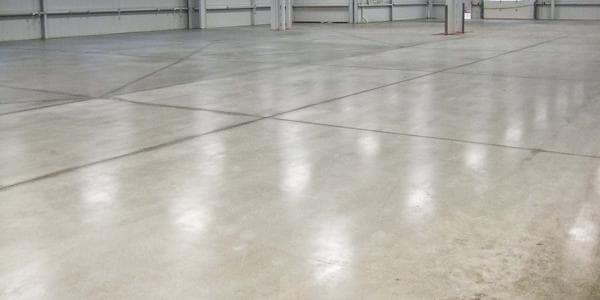
Demands placed on warehouse concrete floors
In warehouse buildings the concrete floor must be:
- Durable - floors must withstand the daily rigger of supporting heavy moving vehicles (such as fork-lifts), conveyor systems & of course the permanent storage racks for many years
- Perfectly flat - any small slope or pitch in level of the storage floor will be obvious with 30-foot high storage racks, & load-weight should be evenly spread
- Impact resistance - in case of incidents e.g. to avoid repairs if heavy storage items are dropped
- Non-slip - to avoid incidents with depot personnel or machinery
- Anti-static - to protect storage of sensitive electronic wares
- Easily cleaned - seamless & offer light chemical protection from cleaning products
- Cost effective - both to install & maintain through its lifetime
Unfortunately, all surfaces are subject to damage during life & it is important to keep on top of concrete warehouse floor repairs to avoid more significant damage & disruption e.g. due to damaged equipment.

Before any concrete floor repair work it is useful to be able to identify the types of defects, & identify the reasons why they might have occurred before considering repair options.
The most common warehouse floor defects & greatest source of maintenance issues are damaged concrete floor joints & concrete slab cracks.
Warehouse concrete floor joint breakdown
Many warehouse flooring repairs are related to the breakdown of joints in the concrete slab. Joints are common throughout the warehouse floor & represent unavoidable discontinuities in any factory or warehouse floor surface.
The most common types of joints formed in commercial warehouse floors are contraction, expansion, & construction joints.
Types of concrete joints
1. Contraction joints
While drying, hardened concrete will shrink by about 1.6 mm per 3 metres of length. To accommodate this shrinkage & regulate the location of crack formation, joints are placed at regular intervals throughout the floor.
These joints are usually sawed into the newly hardened concrete surface around 4-12 hours after the concrete is laid; however, the longer sawing is delayed the higher the potential for cracks to develop & establish themselves (note: steel reinforced concrete requires far fewer contraction joints).

Contraction joints are necessary because although concrete has very high compression strength, it has relatively poor tensile strength (about 1/10th of the compression strength is one rule of thumb). This means that if the shrinkage of drying concrete is constrained by adjoining structures - creating internal tensile stresses - cracks begin to develop in the floor surface.
Rather than completely eliminate cracks, contraction joints create weakened areas where the concrete can crack in a straight line at controlled intervals i.e. they are essentially planned cracks.
2. Expansion joints
These joints allow independent movement of concrete slabs due to vibration, settling, or temperature changes between adjoining concrete slabs, minimising cracking that would otherwise occur if such movements are restrained.

Expansion joints are visibly larger than the control joints & should always be utilised where a concrete slab will join or abut an existing structure of any type (a wall, column, staircase, etc.).
3. Construction joints
This type of joint is not a true ;movement' joint like contraction or expansion joints. These are formed when the placement of the concrete is interrupted (e.g. at the end of a day's work).
Causes of floor joint damage
Warehouse concrete floors are subject to heavy floor load – as a heavy vehicle approaches a joint, the slab will deflect slightly. As it deflects next to a joint, the top edge will crush against the concrete on the other side of the joint (eventually degrading the joints).
To help prevent this, the two sides of the joint may be purposely “tied” together vertically so that one side can't deflect independently. However, floor joints are still the greatest source of problems in industrial & warehouse floors.
This is because without adequate protection the concrete joint edges or 'arrises' are vulnerable to the passing of heavy, hard-wheeled traffic which cause 'spalling' and the joint arrises begin to deteriorate & erode quickly.
If the damage to the floor joints becomes severe & widens, the uneven surface can cause significant damage to the Materials Handling Equipment, tire, resulting in increased maintenance costs & can even lead to health complaints from the operators e.g. because of fatigue & injuries from jolts etc.
It is therefore essential that even relatively minor concrete floor joints are repaired in order to avoid more significant damage & repair disruption.
Floor joint repair options
There are two general concrete floor joint repair options depending on the damage severity.
Mildly damaged floor joints can be repaired by:
- Re-cutting the joint to create smooth & stable edges.
- Removing existing damaged joint filler.
- Replacing the joint with a suitable semi-rigid joint filler & sealant which still allows for some movement in the floor.
- Shaving the joint filler flush with the concrete floor to allow wheeled traffic to move across the joint smoothly.
Severely damaged floor joints, however, are repaired by:
- Removing all damaged or 'spalled' concrete from the joint.
- Squaring-off the damaged concrete edges so that repairs are not feather-edged.
- Replacing the material removed with a durable concrete floor repair mortar.
- Re-cutting the joint so that the original joint position is 'honoured'.
- Replacing the joint with a suitable semi-rigid joint filler & sealant which still allows for some movement in the floor.
- Shaving the joint filler flush with the concrete floor to allow wheeled traffic to move across the joint smoothly.
Cracks in warehouse concrete floor
Concrete crack defects can occur for a variety of reasons & there are various repair options.
Causes of concrete cracks
Cracks in concrete are caused by a number of factors including: temperature cycles, changes in moisture levels, stress loads (such as heavy traffic or heavy objects), ground or building movement, the dehydration process of the concrete slab when it is curing, or poorly placed contraction joints.

Concrete floor crack repair options
The repair of cracks may be necessary to improve the appearance or durability of the structure. Before carrying out any repair, it is important that the cause of the crack is understood and, if necessary, rectified. In general, cracks that have developed & are no longer moving can be repaired.
If a crack is no longer moving - then it can be repaired & sealed prior to applying the new resin flooring system. The best procedure & materials for doing this depends on the width, depth & length of the crack. It is likely that the surface will need opening / cutting out to remove any loose materials & then it can be either 'surface sealed' with a fine epoxy mortar which is pressed into the cracks. Alternatively, the crack repairs can be achieved by structural bonding with low pressure epoxy resin injection products.
If a crack is moving - for example on a daily basis due to temperature changes, filling the crack will simply result in another crack forming adjacent to the original location. If the cracks are still likely to be subject to future movement, then they should normally be treated as joints, cut square, brought through the floor finish & sealed with an appropriate floor joint sealant. Most cracks in factory & warehouse floors occur in close proximity to the joints in the concrete surface.
Other types of warehouse concrete floor defects
Crazing
Crazing is the term to describe a network pattern of fine cracks that do not penetrate deeply below the concrete surface – these are a result of differential contraction between the surface layer & the underlying concrete mainly brought about by drying shrinkage

Curling
This is the distortion (rising up) of a slab’s corners & edges due to differences in moisture content or temperature between the top & bottom of a slab. The top dries out or cools & shrinks more than the wetter or warmer bottom - it can occur at any time up to about 2 years after slab construction.

Delamination
This defect is characterised by thin layers of surface mortar becoming detached from the main body of the slab. The delaminated layer can be up to about 8 mm thick, & its area can vary from a centimetre or two across up to several square metres.

The most common cause of delamination is bleed water becoming trapped underneath the surface layer forming a void under the surface layer which therefore is not bonded to the underlying slab .
Honeycombing
Honeycombing is the term used to describe areas of the surface that are coarse & stony. It may be caused by insufficient fine material in the mix, perhaps due to incorrect aggregate grading or poor mixing.

Popouts
A popout is a conical fragment that breaks out of the surface of the concrete leaving a hole that may vary in size generally from 5 mm to 50 mm but up to as much as 300 mm. The cause of a popout usually is a piece of porous rock having a high rate of absorption & relatively low specific gravity.

As the offending aggregate absorbs moisture or freezing occurs under moist conditions, its swelling creates internal pressures sufficient to rupture the concrete surface.
Dusting
This is the development of a fine, powdery material that easily rubs off the surface of hardened concrete. - dusting surfaces powder under any kind of traffic & can be easily scratched with a nail or even by sweeping.

Dusting is the result of a thin, weak layer (called laitance), composed of water, cement, & fine particles. This is caused by denser cement/aggregate particles sinking from the surface immediately following laying of the concrete slab.
Spalling
This defect appears as circular or oval depressions on surfaces or as elongated cavities along joints. Spalls may be 25 mm (1 in.) or more in depth & 150 mm (6 in.) or more in diameter, although smaller spalls also occur.

Spalls are caused by pressure or expansion within the concrete, bond failure in two-course construction, impact loads, fire, or weathering. Improperly constructed joints & corroded reinforcing steel are two common causes of spalls.
Summary
There are many demands placed on warehouse depot floors. The most common defects that occur in the concrete are cracks in the concrete slab, or arise from the breakdown of the floor joints. There are, however, a number of lasting repair options available, & concrete warehouse floor repair contractors are on-hand to do transform your warehouse floors.
Contact us now if you're looking for concrete floor repair services.